
Most collections are not investments, and that’s fine. A small slice of collectibles has beaten the stock market over long stretches. Many more lost value once the hype faded. If you want to treat part of your collection as an asset, you need three things: buy what stays scarce, keep the condition, and know what you paid and what it’s worth now.
This guide explains what holds value, what quietly eats your returns, and how to track a collection the way you’d track any other investment.
What makes a collectible hold its value
The items that keep appreciating usually share the same traits:
- Supply that can’t grow. Nobody can print more 1952 Topps Mickey Mantle cards or make more 1968 Hot Wheels Redlines. Things that are still being produced, or were made by the million, rarely appreciate.
- Condition. In most categories, condition matters more than anything except rarity. A carded figure, a mint-never-hinged stamp, or a coin in a top grade can be worth many times the same item in average shape.
- Demand that outlasts one generation. Star Wars, Hot Wheels, classic baseball, and WWII history keep finding new buyers. Fads tied to one moment usually don’t.
- Trusted authentication. Grading services such as PSA and BGS for cards, PCGS and NGC for coins, and AFA for action figures give buyers confidence. A certified item is easier to sell and usually sells for more.
- A real market to sell into. Value only counts if someone will pay it. Categories with active auction houses, dealers, and sold listings are easier to cash out of than very niche ones.
The risks that headline prices leave out
Record auction results make the news, but they describe the best example of the best item. The average piece in a typical collection behaves very differently.
- Boom and bust cycles. Beanie Babies once sold for hundreds of dollars and are now mostly worth very little. Sports cards from the late-1980s and early-1990s “junk wax” era were printed in such numbers that most are still worth pennies. Cards boomed again in 2020 and 2021, then cooled.
- Selling costs. Marketplace fees, auction buyer’s premiums, shipping, and grading fees can take a large share of the sale price. A piece that “doubled” may have earned much less after costs.
- Slow sales. You can sell a stock in seconds. A rare collectible can take weeks or months to find the right buyer, and rushing usually means a lower price.
- Storage and insurance. Climate control, display cases, and insurance all cost money every year. Most standard homeowner’s policies cap what they pay for collectibles, so a valuable collection usually needs its own coverage.
- Fakes and reproductions. The more something is worth, the more likely someone has faked it. Reproduction action figures, altered cards, and fake hallmarks on jewelry are common. Buy from sellers you trust and get high-value pieces authenticated.
What about small collectibles like pins and blind boxes?
Enamel pins, blind-box figures, charms, patches, and trading card inserts are cheap to buy and easy to collect in bulk. A few chase variants and limited runs resell for many times their retail price. Most don’t. They cost $8 to $20 new and resell for about the same or less.
With small collectibles, the money is usually lost through disorganization rather than market crashes. Collectors buy duplicates they forgot they owned, miss which variant they have, and can’t find the valuable piece when a buyer asks. If you own a few hundred small items, a photo of each one, its variant, and what you paid will save you more money than any price guide.
How to track a collection like an investment
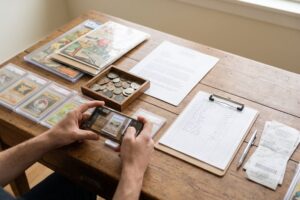
Treating a collection as an asset starts with records. For every piece worth more than a few dollars, keep:
- What you paid and when. Without a purchase price, you can’t tell whether anything gained value.
- Clear photos. Take the front, the back, and any marks, stamps, or flaws. Photos prove condition for insurance and help buyers trust you.
- Condition, in consistent terms. Use the same scale every time, such as mint, near mint, good, fair, and poor, plus any professional grade.
- A current value and where it came from. The best evidence is recent sold prices for the same item in the same condition. Asking prices don’t count.
- Provenance. Keep receipts, certificates, and anything that shows where the piece came from. Provenance adds real value to militaria, signed items, and anything inherited.
Update values a few times a year, not daily. Collectible prices move slowly. Checking too often pushes you toward buying and selling on hype.
Can AI tell you what your collection is worth?
AI can give you a fast first estimate from photos and a description. That helps when you inherit a box of items and have no idea where to start. It can’t replace sold prices or a professional appraisal for a high-value piece. Use the AI estimate to decide which items deserve a closer look, then check recent sales for those.
How Relicara helps
Relicara is a catalog for collectors. Each item gets photos, condition, notes, custom fields, a purchase price, and a current value. From there:
- Free: catalog one collection of up to 10 items with photos, condition, and what you paid.
- Pro: AI value estimates from your photos and details, plus value history charts and a portfolio view of total value against cost.
- Premium: price alerts when an item’s value crosses a level you set, and PDF or CSV exports you can hand to an insurer or keep with estate papers.
Whether or not your collection ever turns a profit, knowing what you own and what it’s worth protects it. That matters for an insurance claim, a sale, or the family member who inherits it.
Start your collection on Relicara for free, or read our guides to Hot Wheels, stamps, action figures, and militaria.