

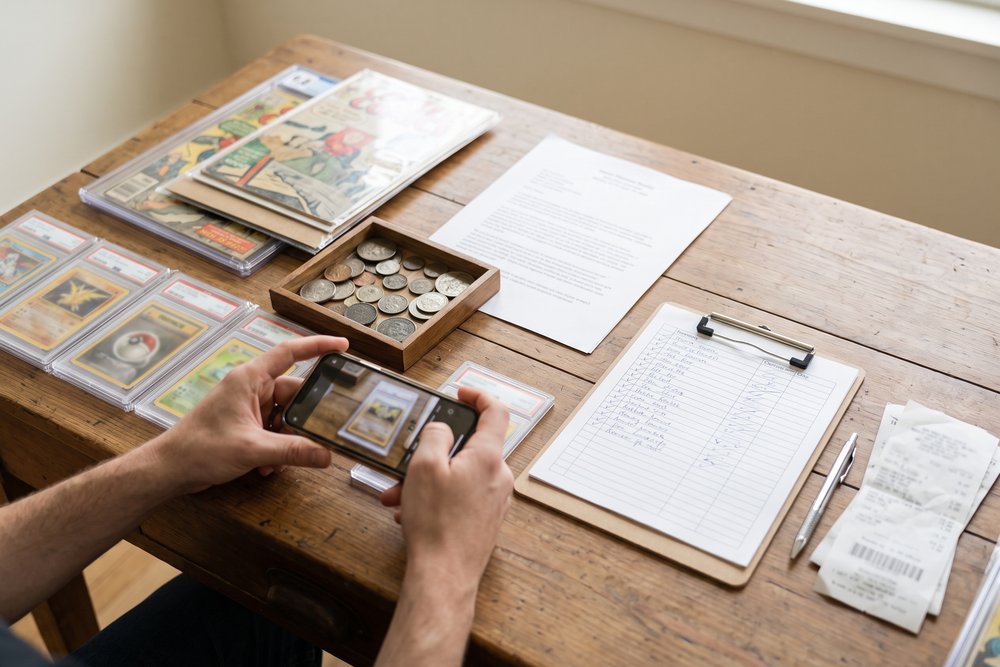
A collection claim is decided before the loss happens. Not by the fire, the flood, or the guy who walked off with your case at a show. By what you can hand an adjuster the week after. Most collectors don’t find out what their policy says about comics, cards, coins, or records until the day they need it. That’s the worst possible day to learn it. So let’s walk through what a claim actually asks of you, then work backwards to what you should have ready now.
Start with the policy you already have
Most people make the mistake of reading the big number on their homeowners declarations page, something like “Personal Property: $150,000,” and assuming the collection sits under it. It doesn’t. Standard homeowners forms carry a list of “special limits of liability,” and the categories collectors care about are on it.
One current endorsement on file with the Maine Bureau of Insurance, built on the standard ISO form, sets these per-loss limits: $200 for money, bullion, and coins. $1,500 for stamps. $2,500 for comic books and trading cards. $2,500 for collectibles, figurines, and glassware. A Farmers homeowners form filed in the same state puts “memorabilia,” which it defines to include trading cards and comic books, at $5,000 on the base form and $10,000 on the upgraded one, with coin and stamp collections at $1,500 or $5,000. And one Farmers policy reviewed by the Merlin Law Group capped cards and comics at $200 per item and $2,500 total.
Here’s the math that catches people. Say you’ve got 300 slabbed cards with a combined last-sale value around $40,000. A break-in takes the whole shelf. Under a $2,500 trading-card limit, the claim pays $2,500, minus your deductible. If your deductible is $1,000, you net $1,500 on a $40,000 loss. That’s not the insurer being difficult. That’s the contract you signed.
Vinyl is a gray area. Some forms don’t name records at all, which drops them under the general personal-property limit. That sounds better until you remember a standard policy pays replacement cost minus depreciation, not what a first pressing brings on the secondary market. Your policy wording governs here, not this post. Pull the actual form, find the special limits section, and read it against your shelves.
What the adjuster will ask you to do
The duties after a loss are written into the policy, and they’re nearly identical across homeowners, renters, and condo forms. The standard conditions require you to:
- Give prompt notice to the insurer or your agent.
- Notify the police if it’s a theft.
- Protect the property from further damage, and keep receipts for anything you spend doing that.
- Prepare an inventory of the damaged or missing property showing quantity, description, actual cash value, and amount of loss, with “all bills, receipts and related documents that justify the figures” attached.
- Show the damaged property when asked, and hand over records the insurer requests.
- Send a signed, sworn proof of loss within 60 days of the insurer requesting it.
- Submit to an examination under oath if required.
Read that inventory line again. Quantity, description, value, loss, and the paperwork to back every figure, for every item. So what happens if you’ve got 300 items and no list? That’s the job you’ll be doing in the worst week of your collecting life, from memory. United Policyholders, a consumer advocacy nonprofit, puts it bluntly: build the list before the loss, because afterwards you’ll be too rattled to remember everything, and what you can’t document you generally can’t collect.
The four things you need per item
Everything an adjuster asks for comes down to four questions about each piece. Can you prove what it is? That it’s yours? What condition it was in? And what it was worth?
Identity. The specific thing, not the category. For a graded card or comic, the grading company’s cert number does the job, because the grader keeps a record you can point to. For a coin, the grade and cert number if it’s slabbed, or the date, mint mark, and variety if it’s raw. For vinyl, the pressing: label, catalog number, matrix or runout etching, country. “Batman 227” is a description. “Batman 227, CGC 9.4, plus the cert number off the label” is evidence.
Ownership. A receipt, an auction invoice, a marketplace order confirmation, or a dated photo of the item in your home. Specialty insurers’ own application forms describe acceptable proof as photos with an inventory list, transaction records, or an appraisal. You don’t need all three per item. You need at least one.
Condition before the loss. A dated photo of the front, back, and the slab label if there is one. For raw items, close-ups of the corners, spine, surface, or sleeve. This is what settles the argument about whether the water damage was new or old.
Value, with a date. Recent comparable sales for cards and comics. A price guide figure or a recent auction result for coins. Marketplace sales history for a pressing. Write down what the number was and when you looked. A value from three years ago is a starting point for an argument, not evidence. One specialty insurer suggests refreshing values or appraisals every three to five years. For a market that moves like cards, that’s the floor, not the target.
Then back it up. Keep the list and the photos somewhere other than the room the collection is in, because a fire that takes the shelf takes the binder beside it too.
Two ways to fix the ceiling
Once you know your numbers, you’ve got two real options, and neither is wrong.
Schedule items on your homeowners policy. You list specific high-value pieces with an agreed value, usually backed by an appraisal, and they’re covered for that amount outside the special limits. It works well for a handful of keys. It gets expensive and tedious at 200 items, and the schedule goes stale as you buy and sell.
Buy a specialty collectibles policy. These are written for exactly this problem. American Collectors Insurance, for example, says a formal appraisal isn’t typically required. It asks only for a description and photo of any single item worth more than $2,000, and the policy pays an agreed value set from market value when you buy it. Collectibles Insurance Services requires scheduling only for items or sets over $25,000 each. Both still expect you to keep a current inventory, and the application is easier when you already have one.
Whichever route you take, there’s a timing trap. Specialty policies usually give new purchases automatic coverage for a window, typically somewhere between a day and 90 days depending on the carrier. After that, the item needs to be on the list. So the card you bought at the show last month may already sit outside your coverage if you haven’t updated anything. Check your own policy’s terms on this one.
After the loss, three things not to do
The things people do in the first 48 hours cost them more than the sub-limits do.
Don’t throw anything away or start repairs before you’ve asked. That includes the soaked long box, the cracked slab, and the warped jacket. The insurer may want to see it, and one specialty insurer’s claims guide says fixing or discarding things first “could affect the claim.”
Don’t guess upward. Adjusters compare your stated values against the same sales data you used. A value you can’t source is a value they’ll replace with their own.
Don’t skip the log. Write down every call, who you spoke to, what they asked for, and when you sent it. Claims drag when both sides remember a conversation differently.
Policies differ by state and carrier, and the only wording that matters is the one on your declarations page and in your form. Read it. And if the special limits don’t cover what’s on your shelves, talk to your agent before a loss, not after. The list is the part you control.
Relicara keeps the inventory, photos, and current values in one place, so the documentation exists before you need it. Start a free catalog at app.relicara.com.