

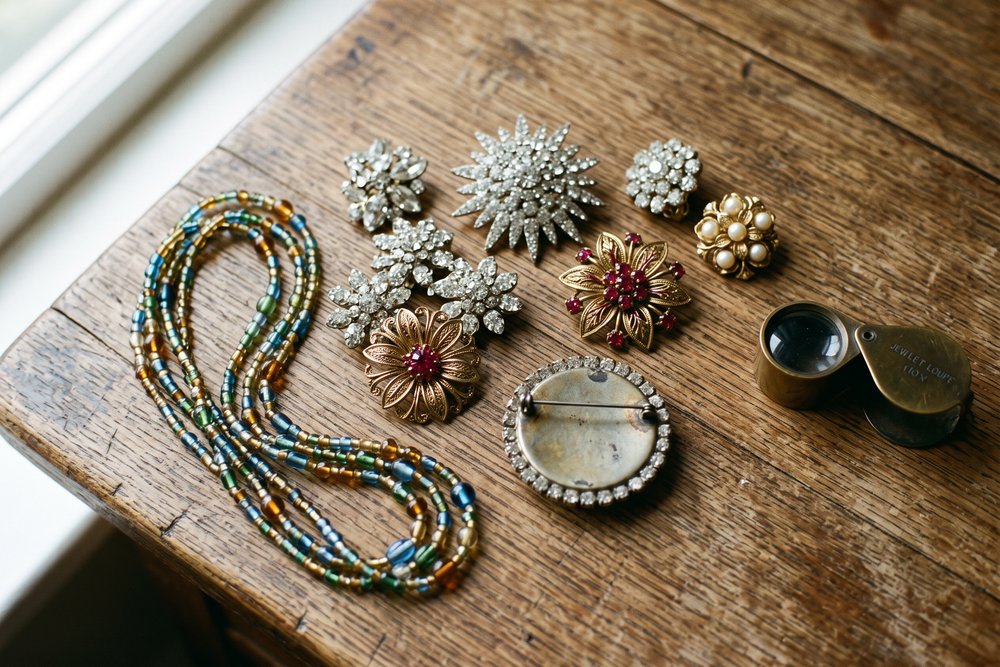
You turned the brooch over and there’s nothing. No Trifari crown, no Coro script, no “sterling.” Unsigned costume jewelry isn’t junk, and it isn’t a mystery either. To identify unsigned vintage costume jewelry, you read the parts the maker couldn’t help leaving behind: the clasp, the earring backs, how the stones are held, and sometimes a patent number hiding where you didn’t look.
Here’s what collectors check, in the order they check it.
Part of our Vintage Jewelry Guide. This is a deep dive on one topic from our complete resource for collectors. Read the full Vintage & Costume Jewelry Guide →
First, make sure it’s really unsigned
Signatures hide. Before you call a piece unsigned, look again with a loupe and good light at every spot a mark can sit:
- the back of a brooch, under the pin stem and near the hinge
- clasps, and the small tag or plate at the end of a necklace or bracelet
- the inside of earring clips, and the paddle on the back
- the back of a pendant’s bail
Marks wear thin on plated pieces, so a faint shape near the clasp may be half a name. Our hallmarks guide covers what metal and maker’s marks look like when you do find one.
Some makers never stamped much at all. They sold through department stores on paper cards and hang tags, and once the tag went in the bin, the piece became “unsigned.” DeLizza & Elster, the firm collectors call Juliana, is the classic case: most of its 1960s jewelry is unmarked, and the “Juliana” paper tags were used for only a few styles, in 1967 (Antique Trader). So a missing name tells you about the paperwork, not the quality.
Date unsigned costume jewelry by its brooch clasp
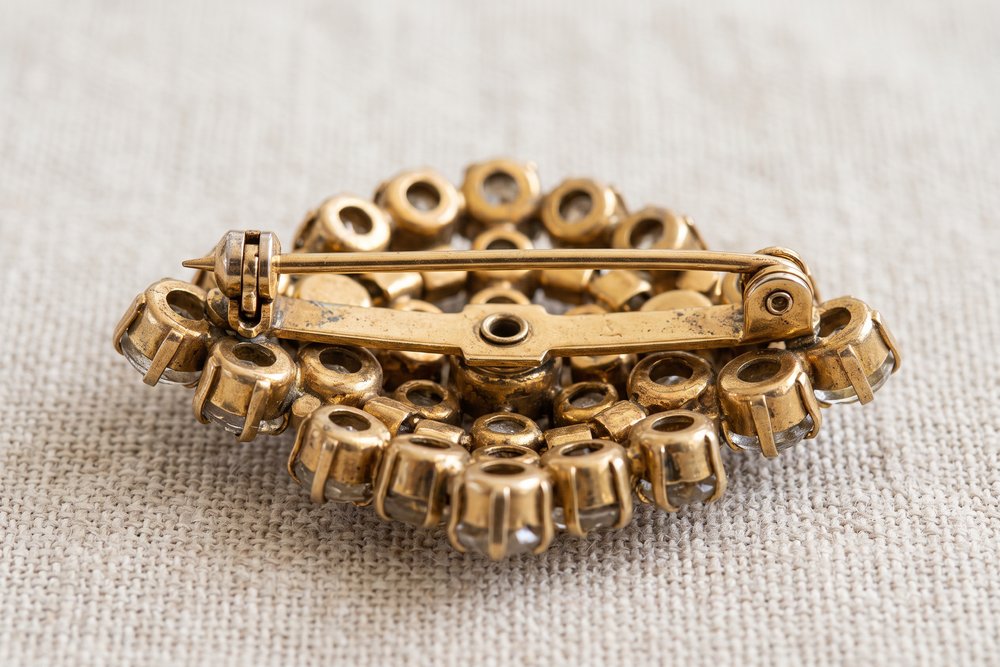
The pin fastening is the quickest rough date you’ll get. A few common types:
- C-clasp. A simple hook the pin rests in, with no lock. Early ones run from the mid to late 1800s into the very early 1900s.
- Trombone (tube) clasp. A small tube you slide to lock the pin. Patented in 1850 and used in Europe until the mid-1950s.
- Locking safety catch. The small rotating catch you see on most brooches today. It shows up from the 1920s on.
These come from Collecting Vintage Jewelry’s clasp notes, and the same writer adds the warning that matters: later makers used modified C-clasps too. So a C-clasp alone doesn’t make a piece Victorian. A C-clasp plus hand-set stones and old-style construction starts to.
Check earring backs and necklace clasps
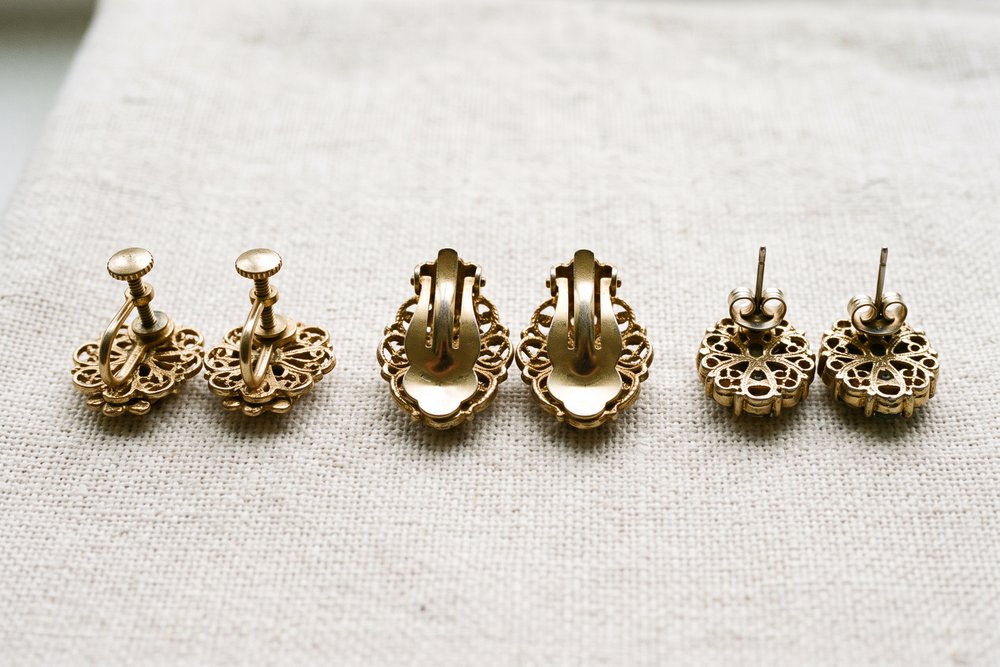
Earrings date well because the backs changed with fashion.
Screw-backs were patented in 1894 and caught on from about 1909 (Navette Jewellery). Clip-ons spread in the 1930s. By the 1950s clips had taken over. One survey of dated Hollycraft pieces found screw-backs on about 30% of earrings from 1950 to 1955, and none at all from 1956 to 1959 (Costume Jewelry Collectors). That’s one maker, not a law. But screw-backs on an unsigned pair point you toward the mid-1950s or earlier.
Necklaces give a similar hint. Coro and Trifari mostly used spring ring, box and fold-over clasps before the early 1950s, and the hook-and-extender (a hook plus a short tail of chain) came in during the 1950s. An original hook-and-extender usually means a piece made in the 1950s or later. Check that it’s original, though. Clasps get replaced.
Look at how the stones are held
Settings tell you more about quality than about age, and quality is what an unsigned piece gets valued on.
Turn it over. Prong-set stones held by small metal claws took time and skill. Stones dropped into cups and glued were faster and cheaper. Neither is a verdict on its own, since plenty of good makers glued some stones. But a heavy piece with prong-set stones, layered metalwork and clean soldering was made by someone who cared, and other collectors will see that too.
While you’re there, check the stones. Foil-backed rhinestones go dull and grey when water gets behind them. Mismatched colors or cuts usually mean replacements. Both cut value, signed or not, as our post on what makes costume jewelry valuable explains.
Hunt for patent and copyright marks
This is the tip most people miss. A piece with no maker’s name can still carry “Pat. Pend.”, “Des. Pat.” or a patent number, often tiny and near the clasp.
Trifari and Coro patented hundreds of designs from the 1930s to the mid-to-late 1950s. After Trifari won a copyright case in 1955 (Trifari v. Charel), the industry largely switched from patents to copyright marks (Costume Jewelry Collectors). So, roughly:
- A design patent number points to the 1930s through the mid-1950s.
- A © mark points to the mid-1950s or later.
A patent number is worth more than a date. Type it into Google Patents and the record often names the designer and the company it was assigned to. That’s about as close to a signature as an unsigned piece gets.
Note the metal, too
Plating that has worn through at the edges and high points shows a different metal underneath, which is normal for costume jewelry. Our real gold or costume post covers the at-home checks.
One twist: during World War II, metal rationing pushed Trifari to switch from base metal to sterling silver (Cooper Hewitt). So a big, showy, gold-washed brooch marked “Sterling” but nothing else may well be 1940s American costume jewelry, not a fine piece.
Match the construction to a maker, carefully
Once you’ve dated a piece, you can sometimes attribute it. Some makers built things in ways collectors recognize. Juliana bracelets, for example, are known for a five-link construction you can see from the back, and D&E brooches often show figure-eight shaped solder marks on the reverse (Antique Trader).
Be honest about what that gets you. An attribution is an informed opinion, not a signature. In listings it’s written “attributed to” or “unsigned, in the style of,”, and it sells on the quality of the piece itself, not on a name. Reference books and maker-specific collector groups are where attributions get checked. If someone online swears your piece is unsigned Haskell, ask them what in the construction says so.
Write down what you found
By the end of this you’ll have a small pile of clues per piece: clasp type, earring backs, setting style, a patent number, a likely decade. That’s exactly the detail that disappears from memory a month later, and it’s what a buyer or an appraiser will ask about.
Photograph the back and the clasp, not just the front. Then put the clues in the notes for that piece. In Relicara you can add custom fields to a collection, so “clasp,” “patent no.” and “attribution” can sit right next to condition and value for every brooch you own. Back to the vintage jewelry guide for the bigger picture.
An unsigned piece is only anonymous until you write down what it’s telling you. Start a free Relicara collection and keep every clue with the piece.


